The breastplate laid out on a study table. From the wearer's left side. The fauld is forced up from its default position.
The breastplate laid out on a study table. From the front. The fauld is forced up from its default position.
The breastplate laid out on a study table. From the wearer's right side. The fauld is forced up from its default position.
Detail of the wearer's right armhole showing the roll, the semi-parallel flute, part of the upper neck flute and part of the edge of the plackart.
Detail of the wearer's left armhole showing the roll, the semi-parallel flute, part of the upper neck flute and part of the edge of the plackart. Looking at the roll we can see sloppy work closing the roll. We see the results of puckers which formed when the edge was tucked back in during final forming.
Detail of the wearer's left armhole showing the roll, the semi-parallel flute, part of the upper neck flute and part of the edge of the plackart.
Detail of the neck roll and flute.
Interior of the breastplate. This shows the overall form. This includes the line formed by the lower edge of the upper breastplate. This seems to be a pretty typical amount of overlap for one of these export breastplates. A normal, full form Italian breastplate generally has much more overlap with an almost straight lower edge. Many German breastplates have even less overlap than this. We also see the central rivet which goes through a slot and leathers at each side. I used to think of this as the typical way a 2 piece breastplate would be build. It turns out, this is just one of 3. The other two are to solidly attach the plates with multiple (non-sliding) rivets and a single central bolt, often with multiple holes in the upper breastplate allowing for some adjustment.
Interior of the breastplate. This shows the flutes in more detail and shows the slot on the inner plate where the two plates are connected by a rivet. The rivet is at one end of the slot.
Interior of the breastplate.
Interior of the breastplate. The focus is good right at the flute along the left arm hole. When we zoom in on it we can see signs of sharp tooling that was used (likely) to support the piece on the inside while the piece was hammered from the outside. We can see places with sharp lines on the sides of the flute where the tool was misplaced and then moved to the right location at the top of the crease. It also shows delamination and signs of semi-cratered surface from rough hammer work on the inside of the piece.
Interior of the breastplate.
Interior of the breastplate. The flute in the plackart also shows sharp tool marks. These seem longer and cleaner than the ones above. The work was likely hard and fast.
Interior of the breastplate. This shows the slot in detail. It also shows nice tool marks and some nice delaimination.
Interior of the breastplate.
Interior of the breastplate.
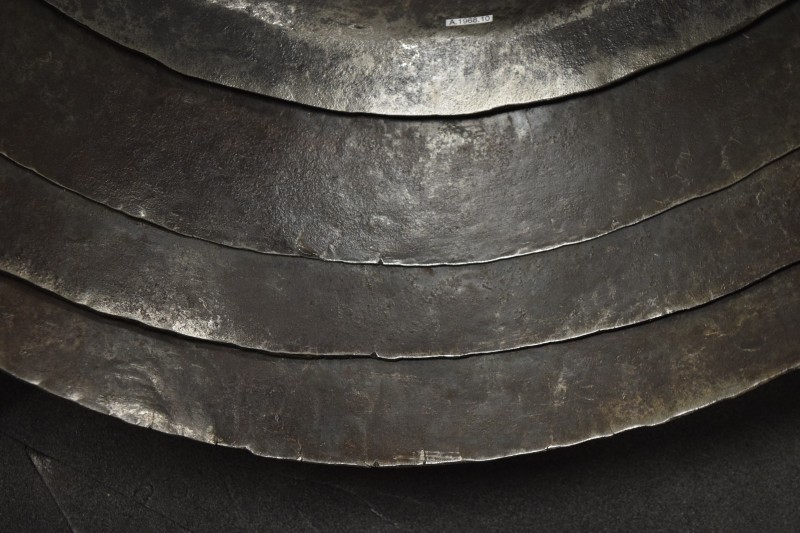
Interior of the breastplate focusing on the fauld. The fauld is being held fully extended. We can see pitting, delaminations, smooth hammer work (typical on thinner material) and a single notch near the center of each plate. These notches are usually described as assembly marks. They would help keep the matching parts together when making multiple similar pieces.
The profile of the breastplate and fauld (the fauld is sticking up because of the table). If we look carefully at the side, we can see rivets in the upper breastplate and the plackart. This indicates that there is almost certainly a leather connecting the plates on the inside.
The profile of most of the breastplate and fauld - the fauld is held up so that it is in its fully extended position.
The breastplate held up to a body to get some idea of fit. The wearer is probably a little taller than the original wearers (so the breastplate could sit a little higher at the shoulder and neck) and he is not wearing proper clothing that would shape the waist.
The breastplate held up to a body to get some idea of fit. The wearer is probably a little taller than the original wearers and he is not wearing proper clothing that would shape the waist.
The breastplate held up to a body to get some idea of fit. The wearer is probably a little taller than the original wearers and he is not wearing proper clothing that would shape the waist.
Right side view showing the relationship between the upper and lower plates when the slot is fully compressed.
Right side view showing the relationship between the upper and lower plates when the slot is fully extended.
Left side view showing the relationship between the upper and lower plates when the slot is fully compressed.
Left side view showing the relationship between the upper and lower plates when the slot is fully extended.
The neck roll showing the form (characterized as triangular) and tapering at the ends.
These images were taken during a study session of a few pieces in storage at the Glasgow Museums in May 2026.
These images are available for study purposes only. They are provided with kind permission of the Glasgow Museums . Any request for reproduction or commercial rights should be directed to the Glasgow Museums . Issues with photography are the fault of the photographer, Wade Allen, and not in any way the fault of the Glasgow Museums .
If you have any questions, please send them to Wade Allen
This site last updated Wed Jun 10 12:54:17 EDT 2026