
These items were chosen for the presentation about collecting armour given as part of The Art of Armor presented by History Live! North East in 2022.
Bio information
Wade Allen
BA University of Virgina in History
MS University of Wisconsin in Computer Science
Former partner with Aaron Toman in Valerius Armouries
Host my collection at www.allenantiques.com and www.european-armour.com
Senior Programmer at IBM, employment 1989-2022
Background in the field of armor:
This shows most of the Allen Collection as of 1982. I owned one other knee cop that has since been sold, and a few non-armour items.
 |
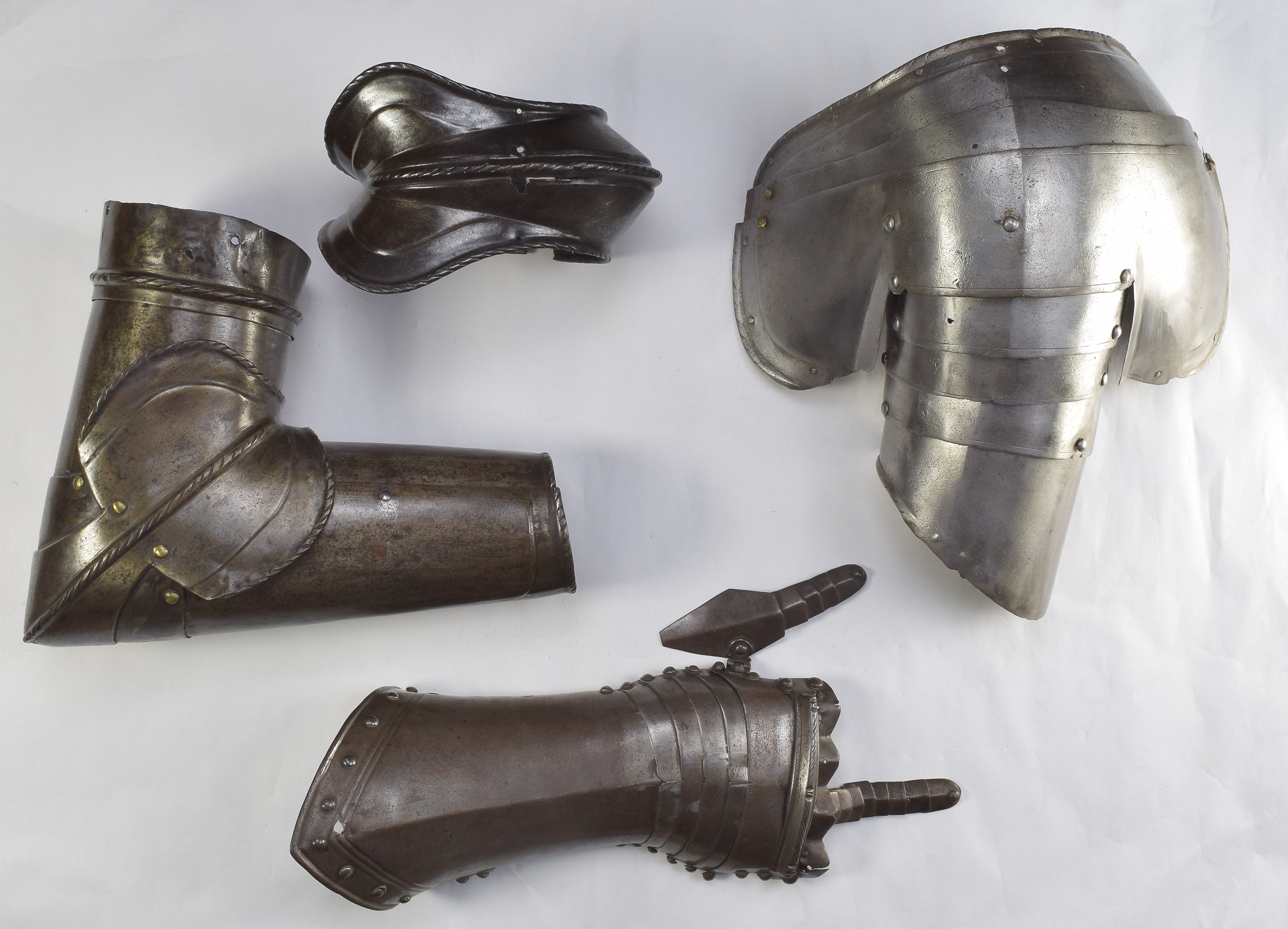
Floating elbow circa 1560 Italian. Of nearly bracelet form. There is a narrow gap of app 1/2 inch between the rear edge of the cop and the wing. The cop is asymetric, being flatter at the back and rising to a peak at the center from slightly behind the point of the elbow through the wing. The wing is slightly larger on one side than the other indicating that this is a right elbow. The outer edges are rolled and roped for their entire length. The roll is bordered by a recessed border on the front portion of the wing. There is a central raised roped band running along most of the raised portion of the cop. There are 2 holes on the front and one at the back for attachment of the cop to the vambrace plates. There is an old collection number in white paint ('178') on the back of the wing. Some delaminations on the inside. Height of cop app. 3 1/2 inches, and the wing app. 5 inches. Length app. 7 1/2 inches from the point of the elbow to the opposite edge of the wing. Weight 9.6 ounces (275 g). [inv. num. A-24]
This was the first piece of antique armor I ever bought. It cost $75. |
|
| |
 |
Italian Pauldron late 16th cent Large main plate overlapping those above and below. 2 plates above, 4 below. Main edges with inward-turned rolls and recessed borders. For use with a floating elbow or with elbow gauntlets. Brass-capped rivets. Leathers and some rivets replaced. Top plate cracked at the center with a modern riveted patch. Thickness varies between .022 and .058 in., mostly .035-.040 in. There seems to be very little pattern to the thickness variation. There has certainly been some loss due to oxidation. Measurements: height at the crease measured over the outside 12 1/2 in. length of the top of the main plate 17 3/4 in. (9 behind the crease, 8 3/4 in front). Weight: 1 pound 13.6 ounces (840 g). [inv. num. A-35]
After that we found two different pauldrons, I bought this one and Aaron bought the other one. Mine was the expensive one, it cost $97.50, Aaron's was $95. Fagan and the Museum of Historical Arms were about all that was easily available in the US and to people with no money. I still regret not buying one of their pieces. It was rotted, but I should have gone for it. |
|
| |
 |
Arm harness circa 1540-60 Formed of an upper and lower vambrace articulated by means of one lame below and one lame above to the bracelet cop. The upper vambrace includes a turning collar which was originally directly attached by a sliding rivet at the back and two leathers to the pauldron. Rolled and roped borders at the wrist and on the edge of the wing. Simple outward rolls at the inner edge of the upper and lower vambraces (at the elbow). Elbow of very pointed form with full bracelet wing. Horizontal raised and roped ridge on the outside from the point of the elbow to the center of the wing. Iron rivets with brass caps articulating the plates and attaching the hinge for the lower vambrace. Turning collar 4 3/4' in diameter. Lower vambrace 9 3/8' long at the longest point. Upper cannon .030-.050' thick, lower cannon more even .030-.040' thick. [inv. num. A-27]
I was studying in Oxford during my second year in college. I took the train down to the Park Lane Arms Fair. I remember seeing a pauldron (should have bought it), a pile of cabassets (they were cheap) and a fun cabasset topped burgonet (I still wish I had that) and this arm and gauntlet. I had no money. After some thought and conversations I convinced this dealer to take what I had and let me send him the rest of the price after the fair. When I had paid off the full price of 125 pounds (for both) he sent them to me. Aaron and I used these pieces and the pauldron to do the design work for the harness we built for Mike Squires and the half armor we built for the Higgins. We learned a lot about the geometry of a 16th c. arm and 16th c. gauntlet from studying these and making those pieces. |
|
| |
 |
German fingered Gauntlet (possibly Brunswick) circa 1540-60 Long, pointed cuff formed with a gentle even flare over the entire length of the cuff. Central point. Border rolled and roped with an additional double row of raised decoration. Lining rivets around the edge of the cuff. Back of the hand covered by 5 articulated plates, the final plate larger than the rest. Knuckle plate decorated with a roped ridge with additional decorative grooves at the end and center. Thumb plate attached by a hinge. Fluted plate joining the knuckle plate to the fingers. One finger remaining. A gauntlet of similar form with similar edge decoration is in the Keinbusch collection in Philadelphia. [inv. num. A-28]
|
|
| |
 |
Half Armour circa 1600 Made for the Higgins Armory for their educational program. [inv. num. R-xx]
This was a piece that Aaron and I made. This was built for the education department at the Higgins Armory. The lessons learned from the pauldron, arm and gauntlet helped us to get this to work correctly. We made a decision to make it with no welds. Raising wasn't as much of a thing then, so the close helmet has a two piece skull with a rolled overlap at the crest. |
|
| |
 |
Mail shirt 17th century Mail Shirt, probably Eastern European. Formed of varying size and thickness rings. The rings over the chest are much heavier than those in the skirt and sleeves. Formed of alternate rows of riveted and solid rings. The rings are 3/8in i.d. The rings at the chest are much thicker than those at the edges. There is a rectangular patch of finer mail under the arm pit. The rings have a roughly 'wankel' cross section. App. 31 inches long. Opens down the entire front. Details show rings from the collar, chest and skirt. Detail images with scale are on an inch scale. [inv. num. M-1]
My first piece of mail. I was wandering the Baltimore Arms Fair and I was looking at a two piece morion and this shirt of mail. In retrospect, I probably shouldn't have bought either one at the price, but this was more interesting. I have since learned a lot more about mail, but it still isn't my area of expertise. Many first purchases will likely not be the smartest, and buying outside of the areas you know is always challenging. |
|
| |
 |
Western European Cabasset circa 1600 Rounded bowl formed in one piece rising to a slight point at the center of the top. Creased along the center and with a small stalk bent backwards at the point. Narrow brim slightly down turned. Brim with inward turn and narrow recess at the edge. Bottom of the helmet bowl with holes for lining rivets. 14 holes. Helmet 7 1/4 inches tall. Inside of bowl 7 inches wide and 8 1/4 inches long. Brim app. 1 inch wide at the sides and app. 1 1/4 inches wide at the front and back point. Acid cleaned. All lining rivets missing. Originally smooth finish. The Royal Armouries bought one of this same series - IV.2018. It is marked with the purported Barberini mark, unlike this one which is unmarked. One of a very large series of morions from a hoard which were sold through Wallis and Wallis in small numbers from 1978 to 2003. The first such example appears to be 26-8 June 1978 lot 1354. This one sole 17 July 1996. [inv. num. A-11]
One of my first cabassets. I was looking for one. I had been for a while. They tended to be about the cheapest helmet you could get and all I had was little pieces. This would be something "real" that normal people would recognize as a piece of armour. I didn't know how auctions worked, and I wanted to get one, and they were selling several, so I faxed over written bids on 5 of the cabassets. Oops. I bought all of them. I didn't know you could write "or" or other instructions on the bid form. |
|
| |
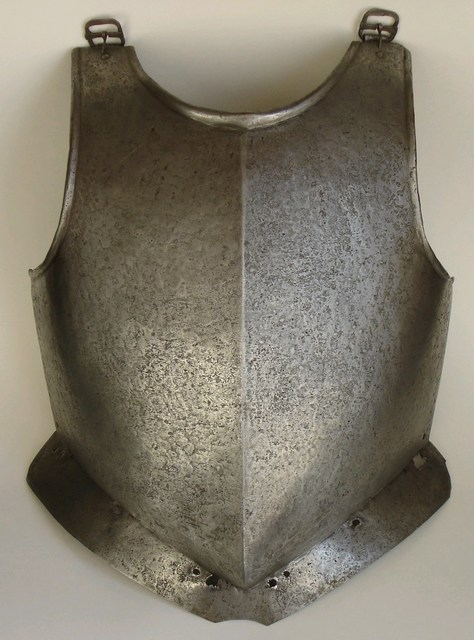 |
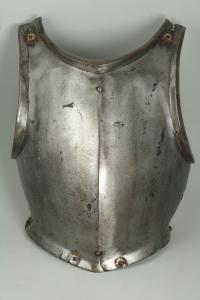
German/Austrian (possibly Gratz) Breastplate circa 1590 Including 2 buckles at shoulders. Rolled edges at arm holes and neck, full flare at waist - used without any fauld lames. Simple peascod shape. This breastplate is relatively light and most likely sword proof and not shot proof. This item is very similar to large numbers of breastplates in the Arsenal in Graz. Its original blackened finish has been removed by cleaning with acid. Originally it would have been used with a pair of tassets suspended directly from the wide flare at the waist of the breastplate - taking the place of the fauld. The holes for the tasset straps are evident. Each tasset would have been suspended by 3 straps and buckles - the ones nearest the edge and center of the breastplate were attached by 2 rivets, the central one with a single rivet. Weight 3.5 lbs. rough inner and outer surfaces, but roughly .050-.060 inch thick overall. [inv. num. A-15]
My first breastplate. I found it at the Baltimore Arms Fair too. I managed to get it from another collector who also has a table there. It isn't really anything special, but it is a pretty decent example of its type. It has been acid cleaned (which pretty much ruins things, but it was common for a while). It really is very similar to many in Graz and it illustrates the form of a late 16th/early 17th c. munition piece very well. The buckles are a really nice example of a really cheap form. |
|
| |
 |
German Burgonet 16th century This burgonet has a finish that was 'rough from the hammer' - the helmet was shaped and plannished with a hammer to its final shape, but it was never ground to eliminate the hammer marks. There are signs that it was then left 'black' - the oxidation from heating the helmet during its construction was not removed - and then probably painted. It has been cleaned recently such that much of the oxidation and any original paint have been removed. The lining is attached to two strips of leather which are riveted to the bowl of the helmet above the face and at the neck (these lines of rivets can be seen in the picture). This would originally have been the type of helmet that was kept in an arsenal and issued to soldiers. Unlike the highest quality custom burgonets, the cheek plates were not originally lined. One of the cheek plates is associated. Complete with tail lame, cheek plates and lining. Linings remaining in armour are very rare. [inv. num. A-3]
My first burgonet. I found it at the Baltimore Arms Fair too. It was covered in spray paint. I didn't know at the time that it has an Augsburg shaped skull similar to the ones we find on Peffenhauser pieces, one cheek plate has been replaced with an associated one and linings in helmets are pretty rare. |
|
| |
 |
Continental Half Suit circa 1640 Continental heavy trooper's armour. It is composed of a bullet proof breastplate (the proof mark may be seen near the middle of the breast), a light backplate (most likely sword proof) and a lobster-tailed pot. These types of armours were worn with buff coats (heavy leather jackets that provided some protection against light weapons like swords). They were used during the mid 17th century - a typical armour of the English Civil War. The form of the breast is similar to that of several examples that have come from northern Europe (Denmark and Sweden). It has flared edges at the arms and waist. There was no need to use a full rolled edge - the in this thickness a flare provides all the strength necessary to deflect weapons. This breastplate was originally lined - it has pairs of holes around the edges for the attachment of a quilted lining. The helmet is typical of the era (especially for continental examples). It has a full 'lobster tail' neck defense composed of 4 lames. On many of the cheaper examples the lames are simulated - these are separate plates. It retains its original cheek defenses and suspension loop at the apex of the bowl (this was used for storage, or to hang it from a hook on the backplate when not in use). The skull is decorated and stiffened by 6 raised ridges embossed into the skull. Each of the portions of this armour is stamped.The leather straps (and shoulder plates) have been replaced. [inv. num. A-2]
My first "suit". I probably shouldn't have bought it. I was on a business trip where I had arranged to stop by London to visit the Park Lane Arms Fair. There wasn't much armour there. This was available... and I didn't have a suit.. and well... I bought it. Then I had to box it up and drag it around Europe on the rest of my business trip. It is exceptionally composed, and none of the parts are really all that good. As it aged in my collection, I was less and less happy with it. I finally sold it off for about what I paid for it many, many years later. (formerly in the collection) |
|
| |
 |
German Morion circa 1600 Black and white. Typical of the Munich town guard. 2 piece bowl with a high comb. Brim with prominent upturned points at the front and back. Each side embossed with a large fleur-de-lys. Provenance: Ackermann Collection, Luzerne. Weight 2 pounds 10.6 ounces (1205g). [inv. num. A-6]
My first Morion. I was on another business trip and I managed to add a visit to Lucerne when Galerie Fischer was holding a sale. It is trouble to arrange a good way to visit both the viewing times and the sale, and then to find a way to actually take pieces away with you. This often requires several days, and coordination with the auction house to get payment cleared. |
|
| |
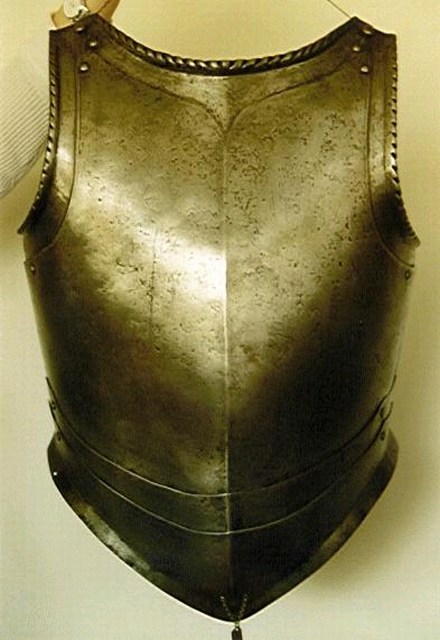 |
Italian Breastplate circa 1580 Roped borders at neck and arm holes. Sliding gussets at arm holes. 2 lower lames at waist. Recessed border at neck. [inv. num. A-16]
An breastplate I bought relatively early in collecting. I stared at it for years and the proportions just looked wrong. A collector/dealer convinced me to sell it to him and I did a little bit of restoration to add a fauld lame (marked with my initials and the date) and hang tassets he owned so that it could become part of a suit. I looked at enough armour after I sold it to determine that it is an example of a mid 16th c. style of breastplate that is relatively rare. I probably shouldn't have parted with it. (formerly in the collection) |
|
| |
 |
Gauntlet finger circa 1370-1400 English. Three finger plates from a fourteenth century English gauntlet, most likely an hourglass gauntlet. Comprising the first, knuckle and second plates. Main plates decorated with raised ridges at the center bordered by pairs of engraved lines. First plate with slightly domed areas at both ends bordered with a lightly engraved line. Third plate with a slightly domed area at the front that is bent down slightly. Knuckle of domed form with a raised ridge the edges with an engraved line parallel to the edge with plain file decoration like simple roping. Each plate with two rivets to secure them to the foundation arranged down the length of the main plates and on the sides of the knuckle plates. Made of iron. Old, mostly stable oxidized finish on the exterior. Found at Queenhithe, London. Publications: Object and Economy in Medieval Winchester Martin Biddle (Fig 349) Medieval Artifacts Nigel Mills. (Fig 245b) and Armour of the English Knight 1400-1450 by Tobias Capwell page 166 - illustrated along with several separate gadlings in private collections. Measurements: First plate 2 3/32 in. long, 1 3/32 in. wide at the back end, 7/8 in wide at the front (measured at the very end before the corners are beveled back). Knuckle 1 3/16 in wide, 31/32 long at the side, 15/16 at the center. Third plate 1 3/4 in. long, 1 in wide at the back and 7/8 in wide at the line demarking the shaped area at the end where it starts tapering more. All width measurements performed flat under the curved plates. Thickness: generally .040-.050 with some thick spots up to .060 in. Weight: [inv. num. A-236]
This came from Ebay. If it hadn't been for one other bidder, it would have been cheap. This is probably my piece with the best documentation and history. It is also my earliest piece of armour. I wasn't watching Ebay much at this point, but some friends were and they were sure that they wanted to get access to the piece and that I would pay more than they could. So they told me about it. |
|
| |
 |
Italian, Flemish or English Three-quarter Suit circa 1550-60 (original helmet c. 1600) Composed Armour. Comprising a breastplate, backplate, morion(when acquired), close helmet, gorget, 2 arms and 2 knee length tassets. The armour is composed, possibly from items from a single armoury or collection (the close helmet was added later from a different source) - at a glance they form an armour but on close inspection the arms do not match and the tasssets are not a pair. The armour retains much black paint finish on all parts. The breast, back, tassets and arms date from 1550-60. The Morion most closely resembles those from c. 1600. The close helmet is also from 1550-70. The breast and backplates fit well together and have similar roped edges. Both are rough from the hammer. they appear to have been originally part of the same armour. The Breastplate has heavily roped borders at the neck and arms. the armholes are formed by a pair of sliding gussets. The breast has the 2 mounting holes used for attachment of a lance rest, so it was originally designed for use by heavy cavalry. Breastplate of mild peascod form with a single lame at the waist. Upper portion of the breast decorated with 2 raised volutes. The gorget is of simple 2 piece form with rolled edges at the neck and around the lower border, possibly 17th century, the style of gorget is typical of pikeman's armours of the 17th c. The helmet is a simple one piece morion with high comb and narrow brim. Comb and edge of the brim roped. Backplate of simple form. Roped borders to neck and arms en suite with the breast. Most of one arm rope lacking due to corrosion. The arms are composed of pauldrons of 9 plates each designed for use either without arms, with floating elbow cops (as currently displayed) or with elbow gauntlets. The elbows are 'floaters' - not articulated to the vambrace, instead being attached to the arms by means of leather straps. They are of bracelet form with pronounced roped medial ridges. The left has a recessed border on the wing. The vambraces are designed for use with floating elbows and are formed of 2 pieces, attached by 2 hinges and secured closed by means of a pin. The left has a recessed border at the wrist, the right is plain. both have roped borders at the wrist and inside of the elbow. The tassets are formed of 9 (right) and 11 (left) plates. They are similar in design and construction, but obviously not a pair. The are secured to the fauld by 3 buckles (the left retaining all three original buckles, the right having 2 original and one replacement). Two buckles on the breastplate, the buckle on the waist belt, all rosette washers and all external leathers replaced. The replacement buckles are well-made modern copies of the original tasset buckles. The rosette washers are stamped with raised daps in each petal. They are two different sizes for larger and smaller straps. The breasplate and tassets are very similar to II. 164 in the Royal Armouries (illustrated on plate LXII of European Armour in the Tower of London,arms this early with similar elbows and vambraces on the Anne de Montmercy armour in the Metropolitan Museum of Art NY). Another similar cuirass with similarly constructed pauldrons is preserved in the armoury at St. Mary's Church at Mendlesham. Another similar cuirass is preserved on Inv. Nr. A 1038, A 837 in Vienna described as Italian, c. 1545. In that case the brestplate has an additional lame at the waist and the pauldrons have turning collars, but the style is very similar. Another similar cuirass is Inv. Nr. A 406 in Vienna dated 1550/55. In this case the form is very similar with the single waist lame and similar rounded roping. The Vienna example is much nicer. Purchased with a later morion, now displayed with item number A-271 which is a close helmet of similar style that survived as a funerary achievement. Originally purchased with item number A-1-a. Now as displayed consists of item number A-1-b, item number A-1-c, item number A-1-d, item number A-1-e, item number A-1-f, item number A-1-g, item number A-1-h and item number A-271. [inv. num. A-1]
My first "real suit" There are always real mish-mash suits that come up for sale. These vary widely in quality, match and amount of armour that is actually old. There were a series of armors that I called Frankensteins. This was one of the better ones. Adding the close helmet helped it a lot. |
|
| |
 |
Armour Late 16th cent A Composite Italian Full Armour of steel. Close-helmet with one-piece skull, visor, upper and lower bevor and 3 neck lames front and back. The skull rising to a tall roped comb (small holes near the top of the comb and one small brazed repair) swept slightly back, bordered by incised lines, with circular holes over the each ear in the form of a circle of 8 holes with a central hole. With a shaped plume-holder incised with chevrons at the base by one rivet on each side. Pointed visor with horizontal vision sight divided centrally, pointed lifting-peg fitting into the upper bevor. The upper bevor fits the visor exactly, the upper edge curved in at the back of the eye slot. Pierced with circular breaths in the form of a circle of 8 holes with a central hole (matching the holes in the skull, but forming a larger circle). on the right and pivoted at the same points as the chin-piece. Chin-piece and upper bevor secured by hooks which engage in to flattened pegs pierced with a hole. Face hole of the chin-piece bordered by a roped inward-turned roll. Face edge of the skull plain with single engraved line. Lining rivets around the face hole flush on the outside. Three neck-plates at front and rear (lower two rear plates replaced), the bottom ones each with turned and roped border and an additional roped ridge parallel to the border. Gorget of two main plates with single neck-lames at the front and rear. The outer edges of the main plates are bordered by a half roll and recessed border, the half roll roped. The neck edge of the main plates with matching roped half-rolls. The neck plates with roped full rolls. The neck plates are secured by an internal hinge at the left and a pin in the rear plate engaging a hole in the front plate on the right. The main plates are secured by a turning hook on the right which engages in a keyhole slot. Breast-plate of deep peascod form with medial ridge and two embossed volutes at the top, moveable armhole gussets, single plate skirt, and later fixed lance-rest. Back-plate shaped to the back and embossed with a 'V' towards the top. Inward-turned roped rolls at the neck, arms and on the edge of the narrow waist flare. Arm holes with recessed borders. Tassets each of five upward-lapping lames. The rounded bottom edge of the final lame with a full inward turn and parallel ridge, each roped. The ends of each plate with roped half-rolls. Each tasset with a central crease and small filed notch at the center of the top edge. Tassets originally designed for 3 buckles, re-fitted for 2 buckles to match the fauld lame on the breastplate. Right tasset with 2 notch assembly marks on inside of the plates. Originally acquired with later fully articulated vambraces each with turning joint, 6 lame pauldrons and floating elbow cops. Currently displayed with mid 16th c. arms from an English household - item number A-164 (right arm) and item number A-165 (left arm). Acquired with later gauntlets each with flared cuff and lames over the fingers (some missing - lost in shipment from auction house). Later full leg harness each hinged together and with articulated round-toed sabatons. Dome-headed rivets throughout. Originally on a padded wooden manikin with modern butted mail apron and mounted on a wooden plinth from its display since WWII. Remounted in the current collection. Helmet, breast and back similar to those on B-13 from Mantova. Gorget very similar to that on Corselet II.47 in the Royal Armouries (illustrated on plate LIX in European Armour in the Tower of London). Breastplate with narrow waist and very deep peascod. Some buckles probably original. Most rivets replaced. All straps replaced. As purchased it consisted of original parts purchased as a "suit" item number A-114a, item number A-114b, item number A-114c and item number A-114d and restoration legs and arms. [inv. num. A-114]
I had been looking for a close helmet for years. They always sold for more than I wanted to pay. That is probably a personal problem, but it is true. I ran across a badly illustrated, badly displayed lot in a catalog. The thing had rusted under varish and the stand was somewhat collapsed. The pound was high then too. So with VAT, Shipping. etc. we were at over 2$ to the bid pound. |
|
| |
 |
Breastplate circa 1550-60 Innsbruck. Officer quality black and white with embossed vine and leaf decoration. Moveable gussets at the arms. Large, tapered, roped rolls at the arms and neck all coming to a point at the center. Original buckles at the top of the gussets, one damaged. Rolled borders of the arms augmented with a narrow embossed line at the center of the gusset. The neck accented by a raised polished section with a parallel raised liine and a small secondary chevron at the center. Roping aparently filed - the rolls with an overall even (not embossed for the ropping) surface. Breastplate with a central crease and deep rounded point at the center. De-laminations on the inside in the lower section of the point and some small ones on the surface. One old patch near the center of the flare and one later patch at the left fauld rivet hole. Black refreshed, white areas lightly cleaned. Gusset rivets replaced. Note from Ian Eaves states: This is actually a nice piece: an officers quality black and white armour made in Innsbruck about 1550-60. The main maker of such armours was Michel Witz the Younger (see for example an armour preserved in the arsenal at Graz). Particularly close in style is an armour by Sebastian Katzmair of Innsbruck in Schloss Churburg (no 118 in the Trapp , Mann catalogue of 1929 as I recall). The breastplate decoration is very similar in form to the breastplate on CH S118 in Churburg (illlustrated page 329 of the new 1996 catalogue and plate LX (b) in the 1929 Mann and Trapp catalogue) Weight: 6 pounds 9 ounces (2975g). Height 13 1/2 in from center of neck roll to center of waist flare, 15 1/2 in. from top to bottom of center point of the flare, 11 3/8 in. wide at the waist, 13 1/2 in. under the arms. Slot in the gussets app. 3/4 in. long. [inv. num. A-241]
Sometimes you luck into things. I got a note from another collector about an item. The picture I saw showed it painted all black. It didn't look like all that much, but after a very light partial cleaning and re-attaching one gusset, I have something that is pretty rare. |
|
| |
 |
German Gauntlet (part) circa 1490-1500 Finger, knuckle and 1 1/2 metacarpal plates of a German Gothic mitten gauntlet. The finger lames are fluted to simulate fingers, the knuckle plate with rounded and creased knuckles. The first metacarpal plate is fluted with v-shaped puckers to accommodate the flutes in the knuckle and finger lames. There is half of the hinge used to attach the thumb plate, and half of the second metacarpal plate remaining. Each of the articulations is formed with sliding rivets with slots app. 1/4 in. long. 2 rivets have been lost, the parts held together by bolts. Formerly in the collection of Leonard Heinrich - armourer to the Metropolitan Museum of Art, NY. Thickness: Generally around .030 in. The back of hand plate is pretty consistently .028-.032. The knuckle plate varies more, generally .025-.030, the finger plates vary even more - .020-030. The hinge is folded over. The overall thickness of the two layers is .060 at the bend, the actual metal is likely a little thinner. The pin is .090 in diameter, the hinge is .450 wide at the pin. The partial plate is 3/4 in. wide at the center, .7 in. at near the bulge at the end, .85 at the bulge for the rivet. The second finger plate is just over 1 in. wide. The first plate is app. 1 1/16 in. wide. The main hand plate is 2 in wide at the first knuckle tapering to 1 11/16ths at the fourth knuckle. Weight: 4.6 ounces (130 grams) There are often questions about how the flutes can work through the range of movement, esp. where the knuckles interact with the metacarpal. The last two images posted show the interaction between the metacarpal and knuckle plates when the hand is straight and when the sliding rivets are fully compressed and fully extended. These show that they really don't work all that well when fully compressed and straight. They do look and work pretty well when somewhat bent and extended. This is just sort of the nature of movement when one plate has tapering flutes. [inv. num. A-47]
I like this piece very much. It has been extremely useful in discussions related the operation and form of gothic and early 16th c. mittens. It probably has no real "collectible" value. This is an example of needing to understand the goal of the collection when buying items. |
|
| |
 |
Gauntlet circa 1590 Italian. Good quality Italian gauntlet for the left hand (fingers and thumb missing) etched in the characteristic Pisan fashion. One piece cuff joined with a rivetted overlap at the inside of flared form with inward turned, roped roll at the edge and a parallel raised, roped line with etching in between. Plain inward turn at the wrist. Back of hand covered by 5 plates and a knuckle plate with rounded areas over each knuckle. Hand plates with internal assembly marks in the form of 5 chisel marks at the edge. Retains some gilding. Ends of the metacarpal plates at the thumb side with multiple decorative notches, single notches on the opposite side. Associated with a lower quality modern copy of a right gauntlet with similar etching. Modern copy not forming a pair. [inv. num. A-244]
This was sold as two gauntlets, one original. I expect that it hadn't been long since they had been displayed together on a suit. They serve to illustrate a lot of things that differentiate a real gauntlet from a much less well executed reproduction. Ignoring the etching and the remains of gilding, the form of the cuff, the form of the back of hand and the interior are dead give aways. |
|
| |
 |
Lot of medieval elements. From the Anthony De Reuck collection. circa Assorted Lot of items. excavated. Mainly buckles. Some mounts and some ring broaches. [inv. num. L-x16]
When you do get side tracked, sometimes you can buy a lot of things all at once. This was one lot of buckles from an auction. This kind of thing can be very catch-as-catch-can. Sometimes there is good stuff in there, other times not so much. Some of these in this left immage are actually nice, but you have to know enough to pick them out. The right image shows another batch of buckles - but many of them are 17th/18th c. shoe buckles, and those are very common and cheap. It is like buying one of those bags of stamps that were sold when I was young. |
|
| |
 |
Lot of medieval elements circa Assorted Lot of buckles. excavated. Shoe buckles in the lower left corner and upper right. Mostly later, 16th-18th c. [inv. num. L-x7]
|
|
| |
 |
Italian or Flemish Breastplate circa 1500 Formed of a single piece with a medial crease, flared bottom edge and large triangular rolls at the arms and neck. The roll at the arm with engraved/filed decoration in the form of lines. There are a set of holes on the right side for the attachment of the pins for a lance rest. This is a fine example of a rare type of breastplate made at the turn of the 16th century. Examples like it may be found in the Waffensammlung Vienna, Metropolitan Museum NY, another in the current collection - item number A-321, etc. For a very similar example see Kienbusch Collection in the Philadelphia Museum of Art #1977-167-132 formerly in the Dean collection. Size measurements: Width of neck hole - 8 1/2 in. Height of arm hole - 9 in. Arm hole to waist- 4 1/2 in. Center from top of roll to waist - 12 3/4 in. Waist flare - 3/4 in. The metal varies in thickness. Within an inch it can vary about .01 inch. All measurements in inches. Thickness measurements:Sides - .028-.052 - mostly in the .030-.040 range. Upper area between arm and neck (right side) - .035-.050.Mostly around .040. Same thing (left side) - .059 - .075 (thicker than the other side). At the lance rest holes - .040 - .052. At the top crease area - .070 - .080 (mostly .080). At the center near crease - .080 - .11. Center near the waist - mostly .040 - .050. Height of upper roll at the center (measured with a gauge from the back of the material)- .66. Max height of right arm roll - .84. Max height of left arm roll - .71. Measuring from the front of the breastplate the rolls height and width at the widest spot are: right 3/4x13/16 inch, left 11/16x3/4 inch, neck 11/16x23/32. To generalize, the armourer was aiming for a roll about 3/4" high and about the same in depth (19mm). [inv. num. A-66]
These are a few items which were not described correctly by the seller. The first was a "breastplate c. 1560". The second a "late 14th c. arm" and the last a "late 15th c. cuisse." |
|
| |
 |
Arm circa 1430 Extremely rare example of a 15th c. piece of armour. Arm for the left arm. Perhaps from the fortress at Chalcis (Negroponte). Formed of a tubular upper cannon that wraps two thirds of the way around the arm connected to a bluntly-pointed cop with an abbreviated wing by one lame. The cop is then connected to a tulip-shaped vambrace formed of two pieces hinged on the outside by hinges and secured by a strap and buckle on the inside. The cop is connected to the vambrace by two lames. The second lame is attached to the vambrace by means of 3 lateral slots allowing the arm to rotate. The lower edge of the vambrace is bordered by a line of small rivets. The lower cannon is marked by an indistinct maker's mark involving a split cross. The upper edge of the upper plate with a narrow, outward-turned roll and a line of rivets securing a (later) leather used to lace the armour to the arming doublet. The inner plate of the vambrace, one lame, lisiere d'arret, one half of one hinge, and all of the rivets replaced. The character of these restorations is similar to the restorations on the Rhodes pieces in the Royal Armouries. Given Claude Blair's association with the Royal Armouries and the presence of the letters HRR on the inside of the inner vambrace plate it is likely that this piece was restored there (HRR almost certainly represents H. Russell Robinson). From the personal collection of Claude Blair. For similar examples see Stephen V. Granscay, The Bashford Dean Collection of Arms and Armour...., 1933, nos. 76-81, pl. V. The most detailed record of the pieces discovered at Chalcis see C. J Ffoulkes, An Italian Armour from Chalcis in the Ethnological Museum at Athens, Archaeologia, LXII (1911) pp. 381-390. Measurements 39 cm long. The arm is 15 in. long overall when straight, upper cannon 5 1/2 in. tall at the center of the cop, 4 5/16 in. wide at the top, 4 3/16 in. wide at the bottom. The upper cannon is 8 1/8 in. around the circumference. The roll at the top of the upper cannon is 1/8 in. tall and 3/16 in. deep. Lower cannon 7 1/4 in. long at the center of the cop, 3 7/8 in. wide at the elbow, 2 5/8 in. wide at the wrist. The cop 3 1/4 in. tall at the center, 2 in. tall at the wing, 1 1/2 in. tall at the back. The slots in the vambrace for rotation are 5/8 in. wide. The hinges are 3/4 in. wide, the upper one is 1 3/8 in. long. The inside measurements of the buckle are 3/4 in. on the wide side of the trapezoid, 5/8 in. on the short side and 5/16 in. tall. The thickness varies significantly. The upper cannon is .040-.090 in., mostly .050-.070 in. The thickest part in the center. The cop is .050-060 on the back and .070-.080 on the front. The outer plate of the lower cannon is generally .070-.080 in the upper center and .050-.060 near the wrist. The upper lame is app. .030 in. and the lower one .040 in. Weight 2 pounds 7.2 ounces (1,110 g). [inv. num. A-186]
This is a piece that shows a style of restoration that was common in the early/mid 20th c. which was more ethical than many. The modern pieces are made to complete the lost bits of the piece but without any attempt to fake. |
|
| |
 |
Cuisse for the left leg circa 1510 Spanish (possibly Flemish or Italian). Formed of a short cuisse plate, a long demi-greave, a central cop and two lames above and below the cop. All formed with a central crease. The cuisse plate slightly boxed and the outside and dished to conform to the thigh. The upper edge of the cuisse bordered by a recessed band and hollow roll. The cop with a raised central ridge and another bridging the transition from the cop to the wing. The wing with a recessed border. The demi-greave cut away on the inside of the bottom and bordered by a recessed band and roll similar to the top of the cuisse. The outside cut off straight. A single buckle remains on the outside of the demi-greave. There are rivets for securing straps and buckles on the cuisse and knee cop. Sold from the Parsons collection as late 15th c. but the character of the piece - forms of the rolls and boxing much more closely approximates 1510 - similar in many ways to the cuisses on Henry VIII's Silvered and Engraved armour. It appears that this was likely originally rough from the hammer and would likely have been blackened. This is very similar in form to the knees illustrated in Albert F Calvert - Spanish Arms and Armour - plates 17(b) and 99. They are described as late 15th c. Other similar items can be seen in Mann - Notes on the Armour Worn in Spain - Archaeologia LXXXIII for 1933 p. 300 fig. 7 and item #183 in the Kretzschmar von Kienbusch Collection of Armor and Arms 1963 - again identified as late 15th century Spanish. There are also two similar pairs in the Harding Collection in Chicago. One of these has been adapted to appear to have a more 15th c. style. One pair and one left very similar pairs are illustrated in armamento Medieval No Espaco Portugues items 21 and 22. These come from Lisboa Museu Militar Inv. MML numbers 21/37 and 21/69. 21/69 is nearly identical to this item.. Provenance: Dr. Peter Parsons Collection (2011), Brian Powers (1980) Measurements - 15 in. overall height - others on the image. Thickness - cuisse .060-.070 in. cop .050-.060 in. demi-greave .040-.050 in. [inv. num. A-200]
|
|
|